

Federal rules limit how long a business can keep batteries, lamps, aerosol cans, and other universal waste on site before it needs to be shipped for proper handling. Universal waste rules generally allow businesses to accumulate qualifying waste for up to one year before it must be sent off-site.
What Qualifies As Universal Waste
Under federal rules in Title 40 of the Code of Federal Regulations (CFR) Part 273, five types of waste can be managed as universal waste.
- Batteries
- Mercury-containing equipment
- Lamps
- Recalled or suspended pesticides
- Hazardous waste aerosol cans
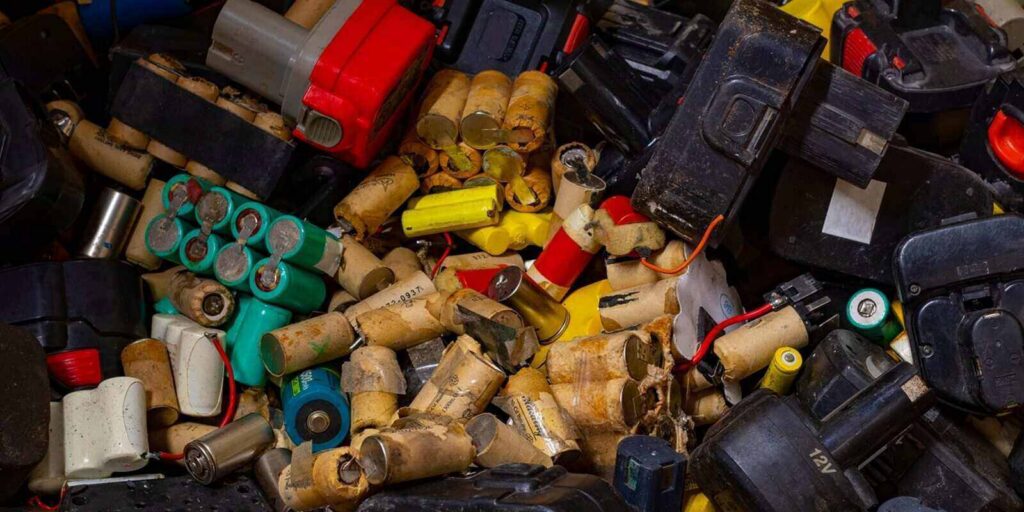
Batteries can include nickel-cadmium batteries, lead-acid batteries removed from machinery, and lithium batteries taken out of tools, forklifts, or backup power systems. Mercury-containing equipment includes thermostats, switches, and relays. Lamps include fluorescent tubes, high-intensity discharge bulbs, and similar lighting removed during renovations or lighting upgrades.
Aerosol cans qualify as universal waste when they would otherwise be classified as hazardous waste. That can include cans containing flammable propellants such as propane or butane.
Aerosol cans, or the containers holding them, must have an approved label such as “Waste Aerosol Can(s)” or “Used Aerosol Can(s).” Leaking cans need separate handling and may require a closed container or an appropriate overpack with absorbent material.
State Programs in Maryland, Pennsylvania, and DC
Federal rules provide the baseline, but state and local requirements can add another layer. That matters for businesses operating in Maryland, Pennsylvania, and Washington, DC, because the requirements are not necessarily identical in every jurisdiction.
Maryland lists aerosol products as universal waste under the Code of Maryland Regulations (COMAR) and also addresses lamp ballasts containing polychlorinated biphenyls (PCBs). Pennsylvania adopted the federal program by reference, making the aerosol-can changes effective Feb. 7, 2020. Pennsylvania also recognizes additional materials, including oil-based finishes and photographic solutions.
Washington, DC, covers aerosol cans under its universal waste rules in Title 20 of the District of Columbia Municipal Regulations (DCMR), Section 4273. Businesses operating across state lines should check each jurisdiction’s requirements rather than relying only on the federal list.
The One-Year Accumulation Limit
In most cases, a business has up to one year from the date universal waste is generated or received from another handler to send it off-site. The requirement appears in 40 CFR 273.15 for small quantity handlers and Section 273.35 for large quantity handlers.
For a business in Maryland or the broader Mid-Atlantic region, that generally means universal waste can remain on site for up to one year, regardless of how much the facility accumulates. If a box of ballasts has been in a warehouse, moving it to a designated accumulation area doesn’t restart the accumulation clock.
A handler can exceed the one-year limit only when additional time is necessary to accumulate enough waste for proper recovery, treatment, or disposal, and the handler can demonstrate that this was the reason for the delay.
In practice, this exception doesn’t cover a facility that accumulates universal waste for too long. It is built for cases where a business is consolidating small volumes toward a full truckload for cost or logistics reasons, and can document that as the actual reason for the delay.
How To Document Your Accumulation Start Date
A business can track dates at the item or container level, or use a system-level inventory. With the system-level approach, an inventory log can track when waste was generated, or a designated accumulation area can be marked with the earliest accumulation date.
The important point is consistency. If lamps sit in a maintenance closet for two months before being moved to the accumulation area, the clock starts when they became waste, not when they were moved.
What Happens When the Deadline Passes
If universal waste stays on site longer than one year without a valid exception, it may no longer qualify for the streamlined universal waste requirements. The material could instead become subject to the broader hazardous waste requirements under the Resource Conservation and Recovery Act (RCRA). That can mean additional requirements for storage, manifests, permits, and other aspects of hazardous waste management. Violations can also carry significant civil penalties, which the EPA adjusts annually for inflation. The current maximum is $93,058 per day, per violation.
During an inspection, regulators can review records, plans, storage areas, and other parts of a facility’s waste management program. A problem with one container can lead to broader questions about how the facility tracks and manages universal waste.
Building a Storage Routine That Holds Up
The easiest way to stay on top of the one-year limit is to record the accumulation date when waste is generated. Trying to reconstruct those dates months later is much harder. Containers and individual items should be dated when they enter storage, with markings placed where employees can easily see them.

Set a reminder for the nine- or 10-month mark rather than waiting until the deadline is right around the corner. This gives the facility time to arrange removal before the one-year limit becomes an issue. Coordinating commercial waste services on a recurring schedule can make that process easier.
Facilities that include batteries, lamps, aerosol cans, and other universal waste in a broader waste management plan can identify aging containers during routine walkthroughs.
Eagle Transfer Services Handles Universal Waste Removal on Your Schedule
Eagle Transfer Services helps businesses across Maryland, Pennsylvania, and the DC region schedule universal waste removal, including spent aerosol cans, around their operational needs. Need help planning your next pickup? Call 410-983-3332 or contact our team to discuss a removal schedule that works for your facility.
About Us
Since 1979, Eagle Transfer Services has been the Mid-Atlantic's trusted partner for safe, responsible, and efficient waste management. Our commitment to dependable service and environmental responsibility hasn't changed in over 47 years — and it never will.
Learn more →I've been using this company for my business for years. They are always on time and professional. I highly recommend them for all your waste management needs!
These guys are great! They always go above and beyond to make sure my trash is taken care of. I would recommend them to anyone.