
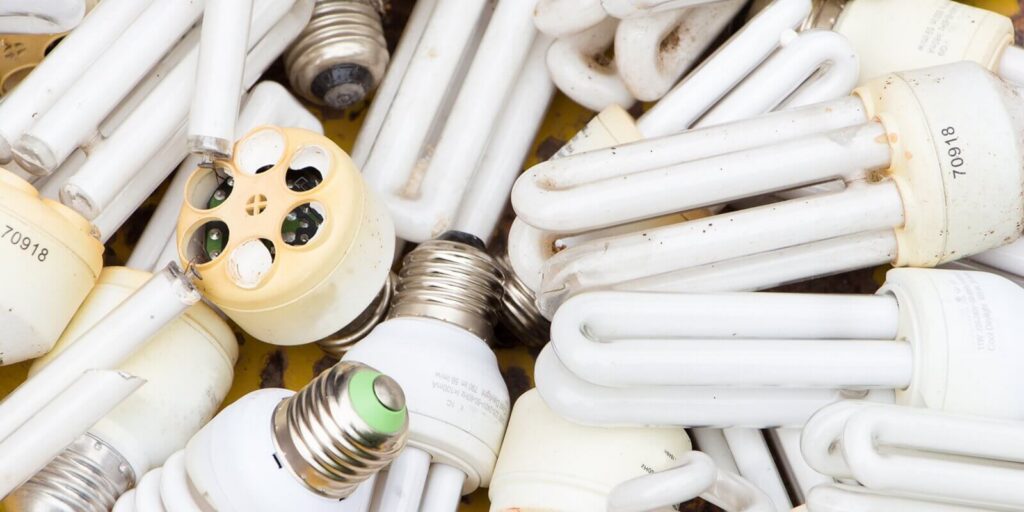


Federal and Maryland rules bar burned-out fluorescent tubes and dead exit-sign batteries from the building’s trash compactor. Regulators call this category universal waste and require separate storage, marking, and shipping standards.
The four types found in most commercial buildings are batteries, lamps, mercury-containing equipment, and aerosol cans.
What Qualifies As Universal Waste in Maryland
The EPA created the universal waste program, with lighter handling rules, to help businesses recycle common hazardous items. The federal list has five categories. Batteries and lamps turn up in almost every building, aerosol cans and mercury-containing equipment in plenty of them, and pesticides hardly ever. Maryland went one step further and added PCB-containing fluorescent light ballasts to the state’s list as a sixth category.
For pesticides to qualify, they have to be recalled, suspended, or canceled. Few offices or warehouses ever have that kind of stock on a shelf. Under the lighter rules, staff have to label these items and send them through a proper handler. A facility that puts them in the general trash gives up that option and answers to the stricter hazardous waste generator requirements.
The Four Universal Waste Items Most Buildings Generate
In a typical building, the universal waste examples cluster in the maintenance room, the electrical closets, and on the shelf for parts pulled during repairs. Dead batteries, burned-out tubes, and old thermostats tend to get dropped into any open carton, yet Maryland wants every carton holding them marked. Knowing what qualifies as universal waste, and which universal waste items go in which container, lets staff sort correctly from day one.
Batteries From Exit Signs, Alarm Panels, and Power Tools
The battery pile in most buildings comes from exit signs, fire alarm panels, handheld radios, and the maintenance crew’s cordless drills. Look at the labels, and you’ll find nickel-cadmium, lithium-ion, and sealed lead-acid mixed together. Every cell becomes universal waste on the day someone pulls it for good. Maryland wants each loose battery, or the container they sit in, labeled with an approved phrase such as “Used Batteries.”
Lithium-ion packs can ignite in transit if their terminals touch each other or stray metal. EPA recommends a strip of electrical tape over the contacts, or a separate bag for each pack, in its battery guidance. Hanging a roll on the bucket handle turns the wrap into a two-second habit, and the driver hauling that bucket later is safer.
Fluorescent Tubes, HID Lamps, and Older Ballasts
Offices commonly use fluorescent tubes and compact fluorescent lamps, while warehouses and parking lots often use high-intensity discharge lamps. Each type contains mercury, and most become universal waste as soon as a maintenance tech takes them down.
Under Maryland’s lamp rules, spent lamps go in a sturdy, closed box packed tightly enough to keep the glass intact. Shards from a broken tube get swept up and sealed separately right away. Crews can reuse the long cartons the replacements shipped in and tape the flaps shut.
Contractors retrofitting lights in an older Baltimore-area building should open each fixture before scrapping the metal. Per EPA, treat any ballast without a “No PCBs” stamp as a PCB unit unless you know it was built after July 1979. In older units, it sits in a small capacitor and the tarry potting around it. Maryland puts these on its universal waste list and wants each one, or its box, marked.
Mercury Thermostats, Switches, and Gauges
If a device needs liquid mercury to do its job, the federal rule treats it as mercury-containing equipment. In a commercial building, that usually means tilt switches, manometers, and the odd temperature or pressure gauge. Then there are the old round-dial wall thermostats. After an HVAC upgrade, a few of them typically end up on a boiler room shelf, and they sit until someone decides what to do with them.
The mercury in each one is sealed inside a little glass ampule. A broken mercury-containing device can release mercury vapor and expose anyone who handles the debris. For mercury-containing equipment disposal, bag every unit and label the container, then store it high, clear of carts and ladders.
Aerosol Cans From Maintenance and Janitorial Closets
EPA only added aerosol cans to the federal rule in 2019, and Maryland adopted the change afterward. Most maintenance closets keep a case or two of spray paint on hand, plus lubricants, degreasers, and cleaners. A discarded can with product or propellant left inside may qualify as hazardous.
One tossed into a janitor’s trash bag goes to the compactor and can burst. Set a closed container marked “Used Aerosol Cans” in each supply closet so staff have a better option.
Regular Trash Is the Wrong Place for These Materials
These four categories contain mercury, lead, cadmium, and pressurized chemicals, which can escape through a cracked battery case or lamp. On a rear-load truck, the crew stands a few feet from the hopper as the packer blade crushes any tubes and cans in the load. EPA has also documented fires started by lithium-ion packs in collection trucks and at processing facilities. Drivers and sorting crews work in both places.
Maryland also holds facilities to a one-year storage limit and requires container labels and handling staff training. A facility with an unlabeled box of spent tubes collecting dust in the basement for three years violates two of those requirements at once.
Build a Universal Waste Pickup Routine That Holds Up
Facilities that handle business universal waste removal well have three pieces in place: a set storage area, dated labels, and a scheduled pickup.
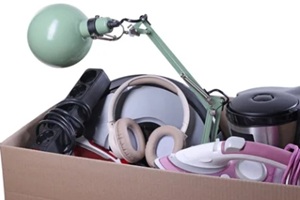
- A set storage area is the one place every spent battery, lamp, thermostat, and aerosol can goes. Maryland lets a facility date the whole spot by its oldest item instead of tracking each piece. For most buildings, that’s a single shelf or a caged corner of the maintenance room. Put a lidded container for each universal waste category on it, and staff can sort as they drop things off.
- Dated labels arethe facility’s proof that nothing has sat past the one-year limit. Maryland gives small quantity handlers 12 months from the day an item is discarded under its labeling and dating standards. Write the start date on the container when the first piece goes in, and have whoever restocks the maintenance carts check it on each run.
- A scheduled pickup is the backstop for that one-year deadline. Most buildings need several months to fill a lamp carton or a battery bucket. Book universal waste collection quarterly or twice a year, and add an extra run after any relamping job. Any qualified hauler can tell you where the load goes next. Under Maryland rules, universal waste can travel only to another handler or an approved destination facility.
Companies with several sites can apply this setup to batteries and lamps disposal at each building and run every location on one collection calendar. Facility managers already using a commercial waste plan can slot these pickups into it.
Schedule Your Universal Waste Pickup With a Local Crew
Eagle Transfer Services has hauled for Maryland businesses since 1979, and our crews provide reliable hazardous waste removal across the areas we serve. Call ETS at 410-983-3332 to reach a live person, describe what’s piled up in the maintenance room, and get everything picked up before the one-year mark. If a message works better, use our contact page, and someone from our office will follow up to book your universal waste pickup.
About Us
Since 1979, Eagle Transfer Services has been the Mid-Atlantic's trusted partner for safe, responsible, and efficient waste management. Our commitment to dependable service and environmental responsibility hasn't changed in over 47 years — and it never will.
Learn more →I've been using this company for my business for years. They are always on time and professional. I highly recommend them for all your waste management needs!
These guys are great! They always go above and beyond to make sure my trash is taken care of. I would recommend them to anyone.