



A repaint or tenant build-out usually ends with a stack of partial cans, and crews cannot toss those into the roll-off with the drywall offcuts. Paint disposal costs for a contractor depend on the state, the county, and whether the leftovers are latex or oil-based. Planning paint disposal before the last coat helps the crew leave the site clean for the final walkthrough.
Maryland Contractors Prepay Paint Recycling at the Counter
Maryland moved the recycling bill to the register on April 1, 2026. Retailers add a small stewardship fee to every container of architectural paint sold in the state. PaintCare, an industry-backed nonprofit, uses that money to run collection under the Maryland Department of the Environment (MDE).
Retailers charge more on larger containers, up to five gallons, and no fee on half pints or smaller. Dropping leftovers at a participating site such as PaintCare Maryland costs contractors nothing extra.
DC runs its own PaintCare program, while Pennsylvania has not passed a stewardship law. Wherever the job sits, the contractor still pays labor to dispose of paint, including sorting cans, driving them to a drop-off site, and booking a hazardous-waste pickup for anything oil-based. An estimator who prices those hours into the bid protects the margin on the back end.
Read the Can Before Sorting the Leftovers
A painter who checks the cleanup instructions on the can will separate the two types in a few minutes. If the label lists soap and water, the can holds latex or another water-based coating. If mineral spirits or turpentine appear instead, the contents are oil-based, and Calvert County manages that category as hazardous waste. Store the two groups apart.
Latex Paint Disposal
Carroll County excludes latex from its hazardous waste collection days because it does not consider it hazardous. Residents harden leftover paint, remove the lids, and place the empty or solid cans beside their weekly trash. The Pennsylvania Department of Environmental Protection (DEP) offers households nearly identical advice (DEP). Both sets of instructions target homeowners, so contractors with commercial quantities need to check county rules for business loads.
A can under a quarter full firms up within a few days with the lid off, while fuller ones need a drying agent stirred in, such as a hardener packet, clay cat litter, shredded newspaper, or mulch. Montgomery County, Pennsylvania, warns that air-drying alone can stretch across several weeks, sometimes months, when a container holds a lot of paint. Contractors with dozens of partial gallons can compare that labor with one PaintCare drop-off trip.
Disposing of Oil-Based Paint
The U.S. Environmental Protection Agency (EPA) and state regulators classify oil-based paint, thinner, and many solvent-based stains as hazardous waste, so the contractor answers for every gallon of those leftovers. Calvert County, for one, turns away businesses and commercial haulers at its household collection program.
A business that produces no more than 100 kilograms (about 220 pounds) of hazardous waste per month sits in the EPA’s lightest tier, the very small quantity generator. Companies at that level still have to determine which wastes are regulated and send them to an authorized facility (EPA). The contractor keeps that responsibility after the cans leave the site. PaintCare takes oil-based products from a business only if the company meets the exempt-generator standard under federal and state rules.
Stage Liquid Paint Away From the Roll-Off

As a roll-off fills and then rides to the transfer point, the load shifts and compresses, and any bucket still holding liquid can burst and soak everything packed beneath it. Project managers who add a no-liquids rule to the construction site paint disposal plan give crews clear direction before loading starts. Each receiving facility decides what it will take, including hardened latex cans, so get the hauler’s answer first.
On day one, set aside a covered, ventilated corner for job-site paint removal, away from the roll-off. Crews sort containers there, reseal anything still wet, and leave dried cans open until they finish curing. When the driver arrives to swap the roll-off, nobody is working around a spill.
Estimating Paint Disposal Cost on a Job
Estimators build a paint disposal cost figure from three inputs:
- Start with pinning down the volume. Retail drop-off locations cap what they will take in a single visit, so a contractor clearing a shelf full of leftovers may make several round trips and lose a worker’s billable time. For 100 gallons or more, PaintCare schedules a Large Volume Pickup at no charge.
- Next, determine the paint type. Latex can go to a PaintCare site or be dried for the trash. Oil-based paint from a business over the exempt-generator limit has to move through a licensed hazardous waste service, and small-quantity generators must complete an EPA manifest for each shipment.
- Disposal method is the input that a contractor controls most. Contractors who use a PaintCare drop-off owe nothing beyond the fee included at purchase. On-site drying uses crew hours, and licensed hazardous waste haulers price their service by volume and material type.
Paint Recycling Options in Maryland, Pennsylvania, and DC
Maryland has 113 year-round PaintCare drop-off sites, and DC has its own PaintCare network. Pennsylvania offers fewer paint recycling options, since the commonwealth has no stewardship law. There, crews dry latex under DEP guidance and send oil-based leftovers to a licensed hazardous waste service or to a county program that takes business waste.
Pull unopened gallons and clean partials aside for the next job before anyone starts drying. Carroll County mentions that certain paint stores accept returned leftovers, so ask the supplier about it while the project is still open. On jobs that cross state or local lines, crews follow the rules where the work takes place.
Build Job Site Paint Removal Into the Bid
An estimator who looks up how to dispose of paint legally in the job’s county can price the right route before anyone opens a can. PaintCare tells painting contractors to get the fee from their suppliers and show it in their quotes. Crews that buy touch-up colors by the quart rather than the gallon end up with fewer half-used cans at closeout.
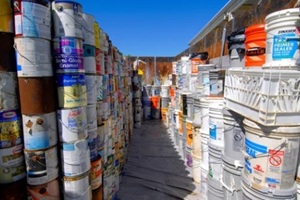
On longer projects, track oil-based gallons as they come off the job so the company stays inside its generator category, and book any hazardous pickup for the same week as the final container haul. When superintendents fold solvents and leftover paint disposal into a written waste management plan, the crew has instructions in hand for the last day, when the pressure to clear out is highest.
Get the Job Site Cleared With One Call
Eagle Transfer Services has deep local roots, working with contractors across the Mid-Atlantic since 1979, and the person who picks up the phone knows how a paint-heavy cleanout differs from a routine debris haul. Call 410-983-3332 to schedule roll-off dumpster service for construction materials and hazardous waste removal for solvents and other regulated materials around your final walkthrough. Or, you can also send us a request through our contact page.
About Us
Since 1979, Eagle Transfer Services has been the Mid-Atlantic's trusted partner for safe, responsible, and efficient waste management. Our commitment to dependable service and environmental responsibility hasn't changed in over 47 years — and it never will.
Learn more →I've been using this company for my business for years. They are always on time and professional. I highly recommend them for all your waste management needs!
These guys are great! They always go above and beyond to make sure my trash is taken care of. I would recommend them to anyone.