

For a growing business, the waste setup usually shows its limits in physical ways, such as a container that overflows before its scheduled pickup or a hauling invoice that no longer matches what the operation produces.
Scalable commercial waste management services fix that by matching container size, pickup frequency, and service plans to current volume and adjusting them as the business grows.
Signs It’s Time to Adjust Your Commercial Waste Service
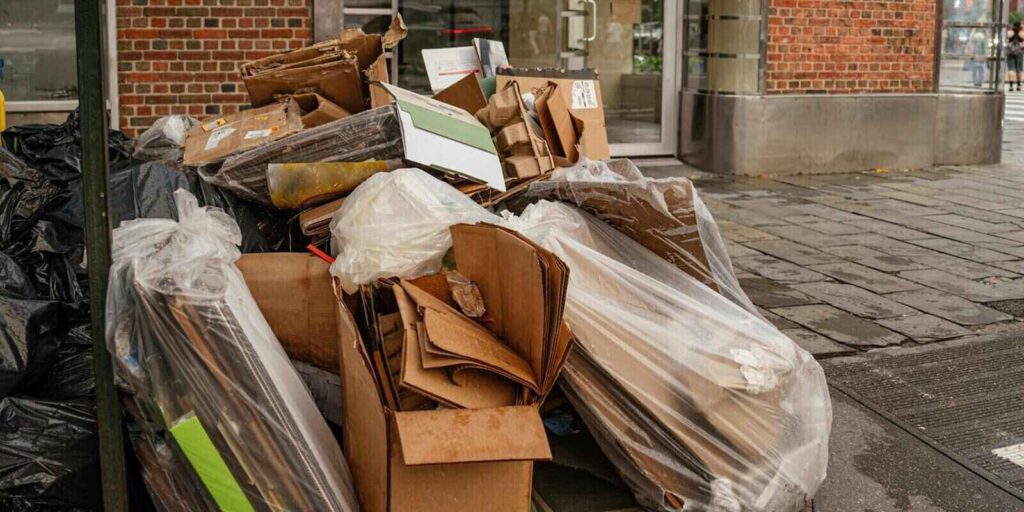
A waste plan slips out of step gradually, so issues surface in daily operations well before they show up on the invoice. A container that is full to the rim before pickup day, debris accumulating on the ground, or repeated calls to schedule an extra pull between regular pickups suggest current volume has surpassed what the setup was built to hold.
On the other hand, containers sitting only half full when the truck arrives signal the opposite issue, since the business is paying for more service than it actually uses.
Both problems trace back to one gap between the plan and current volume, and both problems waste money until the service is adjusted.
Right-Sizing Waste Containers as Your Volume Changes
Right-sizing depends as much on weight as volume, and the most common mistake is picking a container by how much it holds while ignoring how heavy the load is. A retail operation generating light, high-volume cardboard has significantly different needs than a manufacturing floor producing dense, heavy scrap.
For businesses with project-driven or heavy waste, roll-off dumpster services come in 10-, 20-, 30-, and 40-yard sizes, which cover everything from a modest cleanout to an active construction site. As a business grows, adjusting container sizes often involves moving up a size or adding a second container on the same schedule.
Matching Commercial Waste Pickup Frequency to Demand
When a container fills faster than the pickup schedule can keep up, the fix is usually more frequent pickups on the same container instead of a larger bin, especially where space on the property is tight.
The strongest commercial waste pickup services run on schedules built around a customer’s production cycle, and for high-volume sites, a compactor changes the math entirely. Self-contained compactor units handle wet waste from grocery and food service operations, while stationary compactors compress dry recyclables like cardboard so a warehouse can go from several pickups a week down to one.
Cutting the number of hauls also reduces how often a truck moves in and out of a loading dock, which keeps the site safer and less congested during the workday. Pairing the right equipment with strong recycling services also pulls material out of the waste stream, which lowers the volume that has to be hauled in the first place.
How Scalable Commercial Waste Services Handle Seasonal Swings
Flexible waste management plans account for the fact that a retailer’s fourth quarter, a contractor’s summer build season, and a manufacturer’s production ramp all generate different waste volumes at different points in the year. For a known busy stretch, businesses can schedule a temporary increase in container size or pickup frequency for those weeks and drop back afterward.
A waste assessment, which reviews the quantity and composition of what a building actually throws out, gives a business the real numbers behind scaling waste services for growth, so it can match capacity to real demand and negotiate service that fits. A business with several locations can put them all on a single facility waste management plan, so adding a site does not mean a separate account and invoice to track each time.
Commercial Waste Capacity Planning That Stays Ahead of Growth

Good commercial waste service plans are built around the volume a business already knows is coming, like a new production line or an added location, and get that capacity in place well before a missed pickup can back up the operation.
When plans shift, look for a provider that turns the request around within 24 to 48 hours instead of routing you through a voicemail system. What decides a fast swap over a long wait is usually whether the company already has a truck and an empty container running a route nearby. Without that local density, the swap gets scheduled around trucks committed elsewhere, and a new contract ends up waiting on the waste side.
Over 47 Years of Commercial Waste Management Across Maryland
Eagle Transfer Services has handled commercial waste management services for businesses across Carroll County, the 25-mile radius around Finksburg, and the wider DMV region for over 47 years. As your operation grows, we size containers, set pickup frequency, and adjust your service plan to keep pace, and when you call, a real person answers. To scale your commercial waste service the right way, call Eagle Transfer Services at (410) 541-4197 or request a quote online.
About Us
Since 1979, Eagle Transfer Services has been the Mid-Atlantic's trusted partner for safe, responsible, and efficient waste management. Our commitment to dependable service and environmental responsibility hasn't changed in over 47 years — and it never will.
Learn more →I've been using this company for my business for years. They are always on time and professional. I highly recommend them for all your waste management needs!
These guys are great! They always go above and beyond to make sure my trash is taken care of. I would recommend them to anyone.