
A coffee cup with cold latte still in it, a plastic bag holding office paper, and a takeout container with half a meal inside can each turn a clean load of cardboard into a contaminated one.
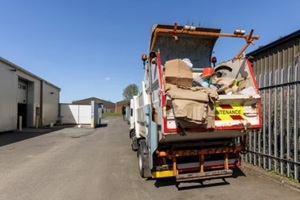
Commercial recycling programsfall apart at the bin, where someone at a desk or loading dock decides where an item goes, long before a truck arrives to collect it. That decision depends on where the bin sits, what stands beside it, and what the signage says, so recycling contamination starts at the point of disposal.
Maryland counties such as Prince George’s and Montgomery set clear expectations for containers and signage for businesses. A simple routine of training and bin checks keeps a business recycling program from drifting after launch.
Common Causes of Recycling Contamination
Employees need an accepted-materials list at the point of disposal to identify which items belong in each bin.
The U.S. Environmental Protection Agency (EPA) says plastic bags, wraps, and films cannot go in a household recycling bin, even though many stores collect them separately. The number inside the triangle on a plastic container names the resin and doesn’t mean the local program accepts the item. Containers with food debris also cannot be recycled, though a scrape or rinse to spatula-clean is enough.
Place Recycling Bins Near Trash Bins
Recycling bins for business spaces go beside every trash bin, as easy to reach as the trash itself. Prince George’s County, MD, requires recycling containers at least equal in size and convenience beside each trash container, inside and outside, including along storefronts.
A 2021 study in Resources, Conservation and Recycling points in the same direction. In the Rosenthal and Linder experiment, 272 undergraduate students in Singapore discarded plastic cups after a yogurt taste test, and recycling bin use roughly tripled when the trash bin sat farther away. The setting was a lab with students rather than a workplace, yet convenience decided the outcome.
What Counts as Contamination in a Business Recycling Bin?
Contamination is anything the local program doesn’t accept, or that arrives too dirty to process, and accepted-materials lists vary by program. Under single-stream recycling, all recyclables share one container, and Prince George’s County tells businesses to confirm with their vendor and processor what qualifies.
EPA’s guidance rules out several common items.
- Plastic bags and film, which EPA directs to store drop-off locations.
- Cups and takeout containers with food left in them.
- Compostable plastics, which are not meant for recycling and can disrupt the stream.
- Plastic utensils, which the EPA lists as not recyclable.
How Maryland Counties Set Business Recycling Expectations
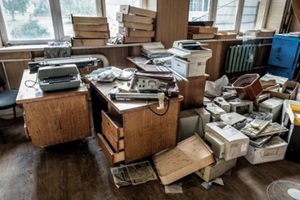
Maryland leaves business recycling rules to its counties so that requirements can change at county lines.
Prince George’s County’s CB-12-2018 covers offices, stores, hotels, restaurants, and factories, and requires a list of recyclable items on or near each container. CB-87-2012 adds clear signage and an annual recycling report. Businesses with a program also submit a Maryland Recycling Act tonnage report, which a hauler may file for them.
Montgomery County businesses must keep a recycling plan, file an annual report, and recycle mixed paper, commingled containers, yard trim, and scrap metal.
Howard County’s program is voluntary. Businesses that report their previous year’s recycling earn Work Green Howard certification.
Training and Routine Bin Checks Keep Programs Clean
Instructions that show what to do with an item work better than ones that explain why recycling matters. In the Rosenthal and Linder experiment, a prompt showing how clean recyclables must be to reduce contamination, while a prompt explaining why rinsing matters did not. A card at each station showing a scraped container applies that finding.
Prince George’s County’s start-up steps include appointing a coordinator and program monitors and educating all employees. A weekly check gives those monitors a concrete job.
- Assign one person per floor or work area to look through the recycling bins.
- Note what turns up, such as bags, food-soaked containers, and items missing from the accepted list.
- Share findings with staff along with a photo of the correct way to prep each item.
- Move or relabel the bin when the same mistake keeps repeating.
A written commercial waste management plan keeps bin locations, the accepted-items list, and the check schedule in one document a successor can pick up.
Request a Recycling Consultation from Eagle Transfer Services

Eagle Transfer Services offers commercial recycling services based on each site’s container needs, service frequency, separation requirements, and pickup schedule. A consultation can help determine which arrangements fit your building’s operations.
Call 410-983-3332 before you change bins, signage, or providers. A live person answers, and service reaches Howard, Montgomery, and Prince George’s counties, along with the rest of the service area. Office properties can start with office waste management, or you can request a consultation online.
About Us
Since 1979, Eagle Transfer Services has been the Mid-Atlantic's trusted partner for safe, responsible, and efficient waste management. Our commitment to dependable service and environmental responsibility hasn't changed in over 47 years — and it never will.
Learn more →I've been using this company for my business for years. They are always on time and professional. I highly recommend them for all your waste management needs!
These guys are great! They always go above and beyond to make sure my trash is taken care of. I would recommend them to anyone.